


Reducing Greenhouse Gas Emissions and Intensity
CPChem understands the significance of climate change and is taking action to support the global transition to a lower carbon future.
Carbon Intensity Aspirational Target
In 2022, CPChem announced an aspirational target for 2030 that aimed to reduce the company’s operated Scope 1 and Scope 2 carbon intensity by 15% compared to a 2020 baseline. The company has updated its aspirational target to remove the 2030 timeline. This adjustment reflects strategic assessments of changing policy and regulatory conditions and the significant economic realities that make large-scale carbon intensity reductions challenging.
CPChem’s approach is grounded in disciplined business practices that safeguard long-term resilience while recognizing that meaningful progress depends on supportive market signals and enabling policy and regulatory frameworks. Industry-wide headwinds, evolving technologies, and volatile market dynamics require flexibility to ensure CPChem’s targets remain aspirational and achievable.
This update reinforces CPChem’s commitment to advancing carbon intensity reduction initiatives that align with operational feasibility and strategic objectives, while acknowledging that sustained progress will require collaboration across industry, investment and regulatory ecosystems. CPChem remains confident in its sustainability strategy and will continue efforts to reduce carbon intensity, maintain sustainable growth and contribute to a lower-carbon future.
Marginal Abatement Cost Curve (MACC) Process and Solutions
CPChem’s MACC process leverages ideation and research to develop site-specific emissions reduction and energy efficiency strategies for our existing assets.
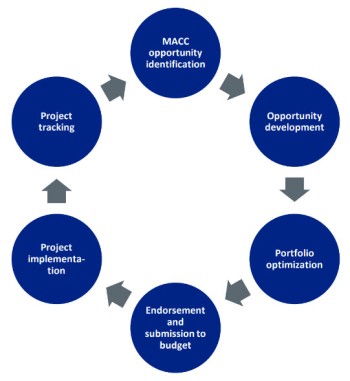
The MACC process brings site teams together to compile a comprehensive collection of opportunities to abate emissions. Team members are encouraged to embrace innovation and creativity in pursuit of strategies and optimizations that are intended to make operations more sustainable.
Together, our multi-disciplinary teams have put forth upwards of 800 concepts and ideas covering immediate and long-term solutions for emissions reductions and decarbonization projects. Information and ideas generated from CPChem’s MACC Assessments will play a critical role as the company works to achieve its climate goals.
Addressing Scopes 1, 2 and 3 Emissions
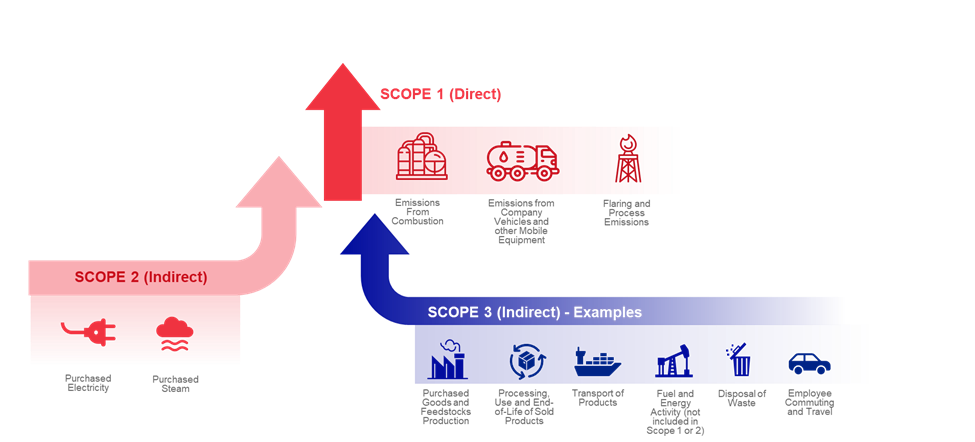
The Greenhouse Gas Protocol provides standards, guidance and resources to help manage and measure climate-warming emissions, which are categorized into three scopes.
Scope 1
Scope 1 emissions are direct emissions from sources owned or controlled by a company like CPChem. The majority of CPChem’s Scope 1 emissions result from the combustion of fuels in ethylene furnaces and steam boilers and from flaring.
CPChem continues to explore cost-effective solutions to increase energy efficiency and reduce its Scope 1 emissions .
Scope 2
Scope 2 emissions are indirect emissions associated with purchased energy such as electricity or steam. More than 15% of our total Scope 1 & 2 GHG emissions are derived from the purchase of third-party-generated electricity, and it is the leading source of GHG emissions from our polyethylene assets. We anticipate that our third-party electricity providers will continue to expand their use of renewable energy and natural gas to further reduce the emissions associated with producing grid electricity, alongside our own efforts to procure renewably sourced electricity.
Scope 3
Scope 3 emissions represent indirect emissions not included in the previous categories, generated throughout the value chain, both upstream and downstream.
To measure and reduce the impact of Scope 3 emissions, CPChem is conducting a comprehensive analysis of its value chain and suppliers. Although our Scope 3 emissions data is not yet available, we are actively working to assess these emissions and we intend to publish this data in the future.
We aim to work together with our customers and suppliers to further reduce Scope 3 emissions, and our Responsible Sourcing Program helps us select suppliers who also prioritize these efforts.
Explore our Performance Data to learn more about emissions at CPChem.
